Two-Row Adventure Focus or Three-Row Family Flexibility?
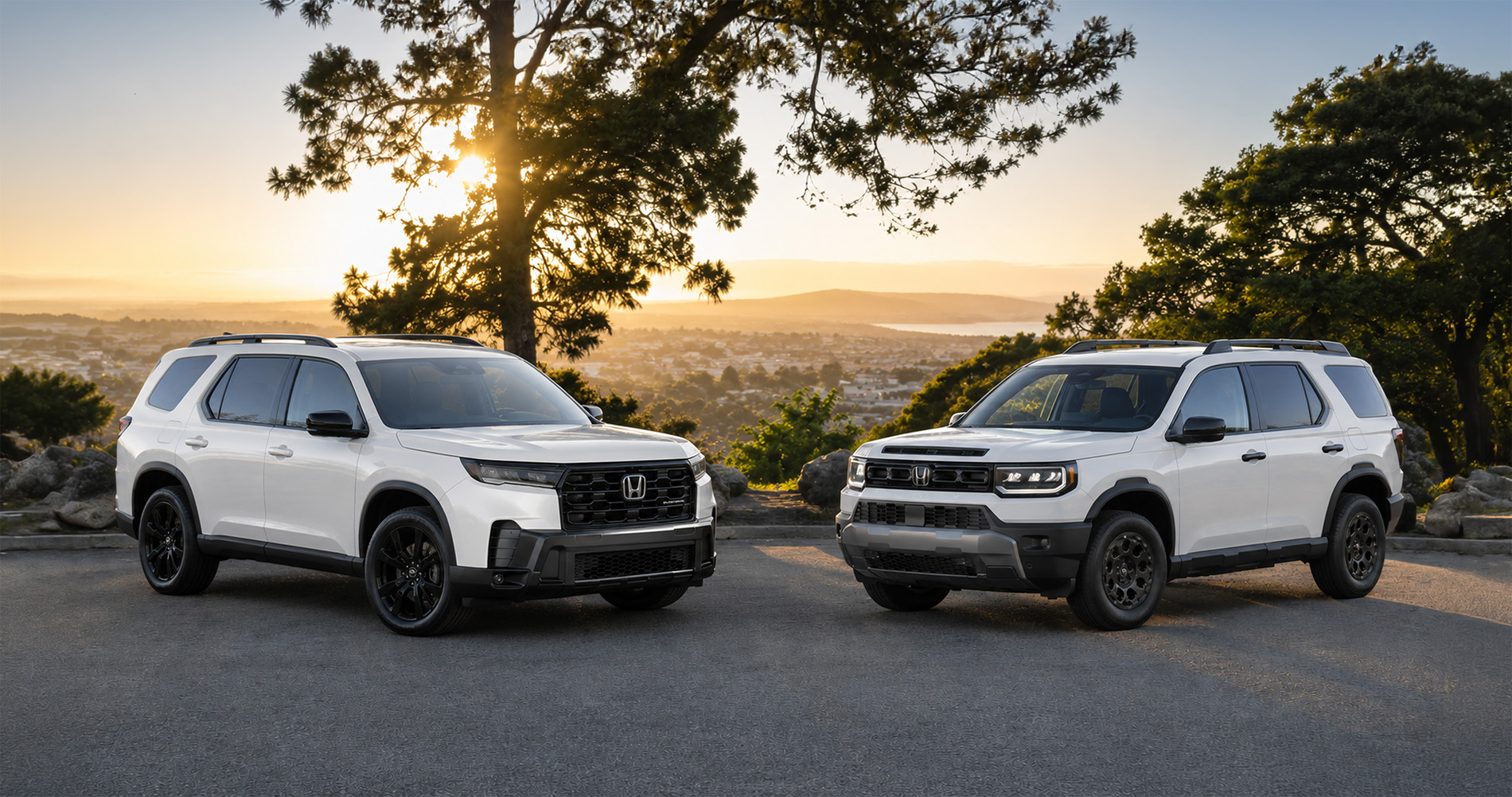
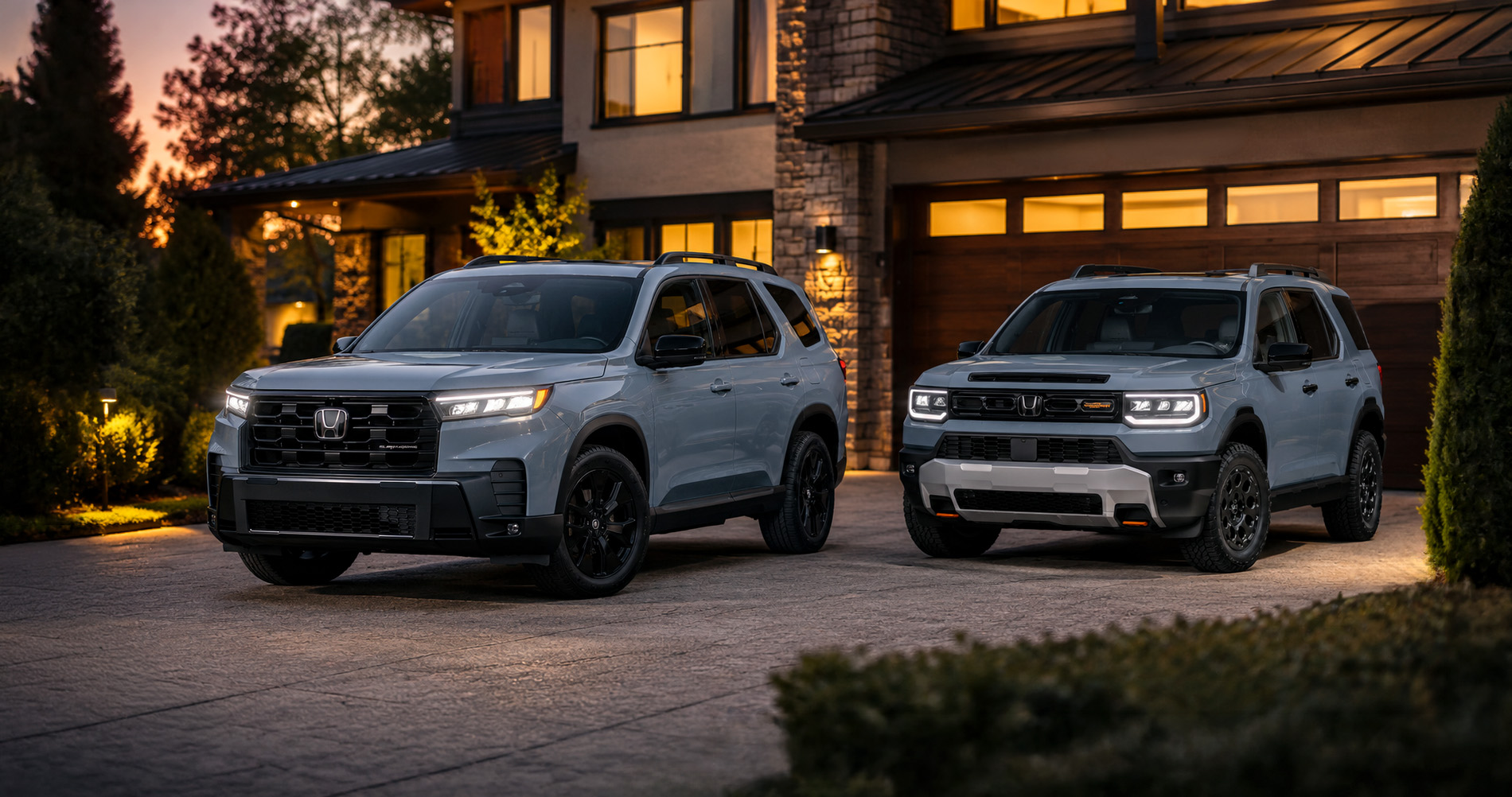
The 2026 Honda Passport and 2026 Honda Pilot share a 285-horsepower V6, a 10-speed automatic transmission, Honda Sensing technology, and familiar Honda controls, but they are designed around different ownership routines. The Passport concentrates on five-passenger space, standard all-wheel drive, a shorter two-row body, and a more adventure-oriented lineup. The Pilot adds a third row, broader seating configurations, more trim choices, and the flexibility to carry a larger household.
This Honda Passport vs Pilot comparison explains the differences that matter after the test drive: seating capacity, cargo strategy, exterior dimensions, parking, MPG, towing, TrailSport equipment, technology, comfort, and trim direction. It also separates shared Honda engineering from the packaging choices that make each SUV better suited to a different type of buyer.
The Passport is the more focused choice when five seats are enough and the cabin can prioritize people, dogs, luggage, sports equipment, or outdoor gear. The Pilot is the more flexible choice when carpools, relatives, growing children, or mixed passenger-and-cargo trips make a third row useful. Neither is universally better; the right answer depends on how often the extra seats would actually be used.
Quick AnswersThe essential 2026 Honda Passport vs Pilot differences▼
What is the main Honda Passport vs Pilot difference? The Passport is a two-row SUV with five seats and standard AWD. The Pilot is a three-row SUV with seven or eight seats, depending on trim, and offers both 2WD and AWD configurations.
Is the Passport smaller than the Pilot? Yes. The Passport is 191.5 inches long, while most Pilot trims are 200.1 inches long. The Passport is slightly wider, however, and the Pilot has a slightly tighter listed turning diameter, so parking feel should still be compared in person.
Which has more useful cargo space? The Passport dedicates its rear cabin to two-row cargo use and lists 44.0 cubic feet behind the second row. The Pilot adds about 19 cubic feet behind its third row and more maximum volume with both rear rows folded, making it better for changing combinations of passengers and luggage.
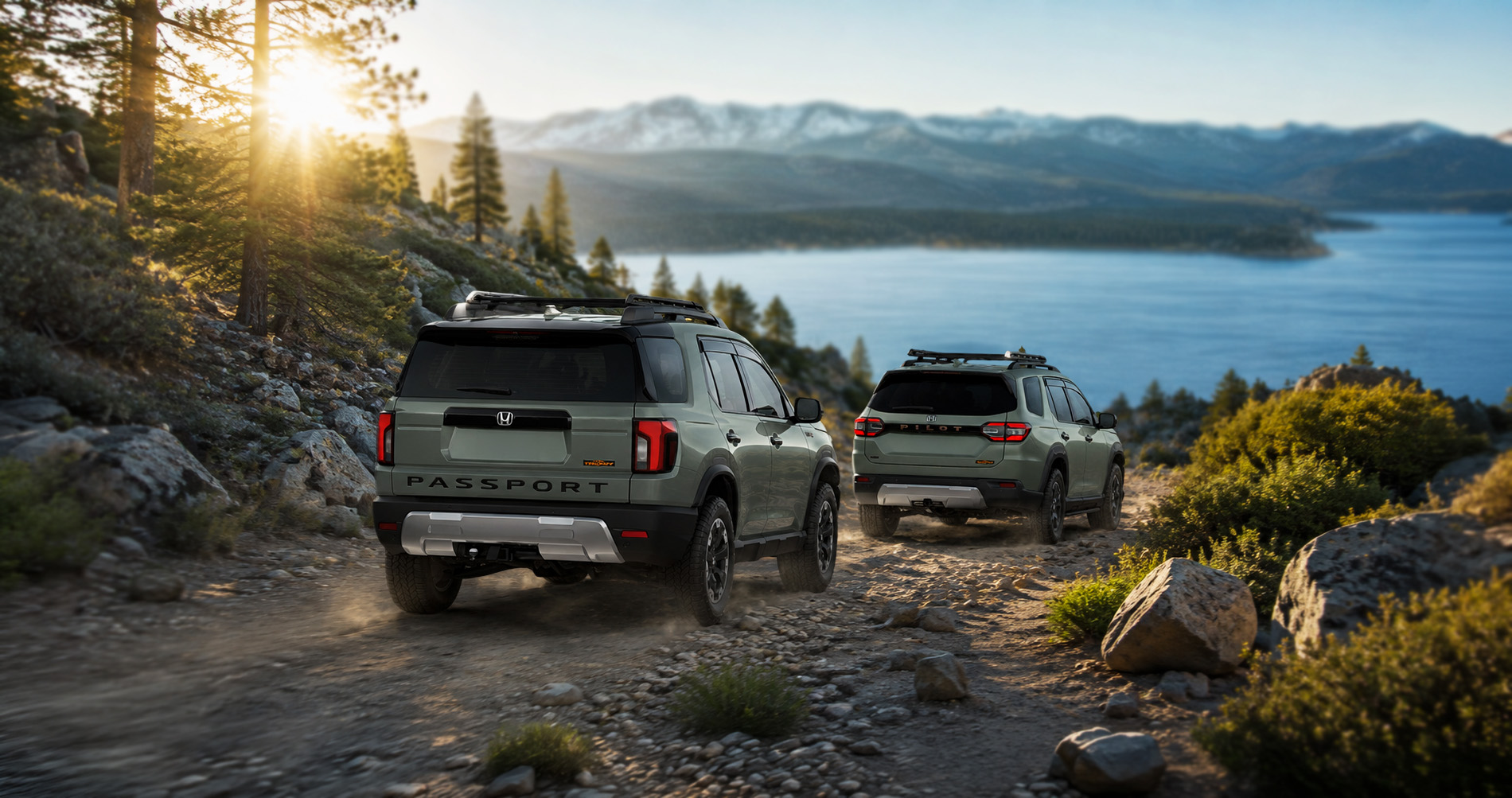
Is the Passport better for off-road driving? The Passport has a stronger trail-oriented identity across its lineup, and its TrailSport models add off-road-tuned suspension, skid plates, recovery hooks, and all-terrain tires. Pilot TrailSport remains a legitimate alternative when three rows are needed with 8.3 inches of clearance, TrailWatch, skid plates, all-terrain tires, and an integrated hitch.
Which one should I test-drive first? Start with the Passport when five seats, standard AWD, and a shorter body match your routine. Start with the Pilot when a third row could prevent passenger compromises. At El Cerrito Honda, compare second-row access, cargo loading, visibility, parking, and seat comfort back to back.
Core Differences: 2026 Honda Passport vs 2026 Honda Pilot
Start with the ownership role rather than the shared engine. The Passport keeps its cabin focused on five people and their gear, while the Pilot devotes more of its length and interior flexibility to a third row. That choice affects parking, seating routines, cargo loading, drivetrain selection, trim variety, and the way each TrailSport model fits into a household.
2026 Honda Passport vs 2026 Honda Pilot at a GlanceShopper-level differences only. Detailed specifications, trim notes, and equipment appear in the comparison slider below.
Category
2026 Honda Passport
2026 Honda Pilot
Core Identity
A dedicated two-row midsize SUV with five seats, standard i-VTM4 AWD, and a stronger adventure-oriented lineup identity.
A three-row midsize SUV with seven- or eight-passenger configurations, broader trim variety, and family-focused flexibility.
Best Fit
Couples, smaller families, dog owners, outdoor gear, and households that rarely need more than five seats.
Larger families, carpools, grandparents, visiting relatives, and buyers who need flexible passenger combinations.
Seating Strategy
Five seats and a wide, dedicated second row with no third-row access or packaging compromise.
Three rows, one-touch second-row access, and a removable or stowable second-row center seat on applicable trims.
Drivetrain Direction
Standard i-VTM4 AWD and seven drive modes throughout the lineup.
2WD or available AWD on lower trims; AWD is standard on TrailSport and upper configurations.
Size Meaning
191.5 inches long and 79.4 inches wide. The shorter body can be easier to place in garages and curb spaces.
Most trims are 200.1 inches long and 78.5 inches wide. The extra length creates room for the third row.
Cargo Strategy
44.0 cubic feet behind the second row, plus underfloor organization and a large two-row load area.
Cargo behind the third row for full-passenger trips and greater maximum volume when both rear rows fold.
TrailSport Direction
Rugged two-row role with off-road-tuned suspension, skid plates, recovery hooks, all-terrain tires, and integrated hitch equipment.
Three-row trail capability with AWD, added clearance, skid plates, all-terrain tires, TrailWatch, captain’s chairs, and an integrated hitch.
Trim Direction
A concentrated RTL, TrailSport, and TrailSport Elite progression with towing and blackout configurations.
A broader Sport, EX-L, TrailSport, Touring, Elite, and Black Edition progression.
What These Differences Mean
The Passport makes the most sense when a third row would spend nearly all of its life folded. Its 40.9 inches of second-row legroom, broad cargo floor, underfloor storage, and standard AWD support a routine built around five people or fewer. That can be a cleaner ownership solution for a couple with dogs, a family with one or two children, or anyone who usually carries gear instead of extra passengers.
The Pilot earns its additional length when passenger needs change from week to week. Its third row can handle children, friends, or occasional adult passengers, while applicable trims let the second-row center seat remain installed, fold into the cargo well, or be removed. That flexibility matters more than a shorter body when one vehicle has to cover school, family visits, airport runs, and vacations.
Parking is not a one-number decision. The Passport is about 8.6 inches shorter, which reduces the amount of curb or garage length it occupies. The Pilot is slightly narrower and lists a marginally tighter curb-to-curb turning diameter. El Cerrito and Berkeley shoppers should compare mirror clearance, rear visibility, camera views, and low-speed steering effort rather than assuming one dimension settles the question.
TrailSport is a real capability path in both lineups, but it supports different packaging needs. The dedicated TrailSport comparison below separates their geometry, recovery hardware, camera systems, seating layouts, and cargo priorities without treating either model as a cosmetic package.
Third-Party Review Snapshot
How Reviewers Assess Each SUV’s Mission
Car and Driver evaluates the Passport and Pilot in separate two-row and three-row SUV classes. The ratings provide useful context, but they are not a direct head-to-head verdict.
Review takeaway: Reviewers praise the roomy two-row cabin, straightforward controls, quiet road manners, and rugged equipment that does not undermine everyday comfort. The strongest case is cohesion: the Passport feels designed around its five-passenger, cargo-focused mission rather than simply shortened from a three-row SUV.
Review takeaway: Reviewers emphasize the Pilot’s comfortable ride, stable road behavior, straightforward controls, usable third row, and strong family practicality. Its value lies in solving a broader passenger problem while remaining easy to operate, not in matching the Passport’s two-row ranking or accolade count.
What the scores mean for shoppers: The Passport has the stronger current two-row accolade story. The Pilot competes in a different class and should be judged by whether its third row and added flexibility solve needs the Passport cannot.
Compare the 2026 Honda Passport & Pilot by What Matters Most
Choose a topic to compare power, AWD, MPG, towing, seating, cargo, dimensions, TrailSport hardware, technology, safety, reliability and warranty coverage, trim pricing, and buyer fit. Each panel groups related details so the numbers remain easy to scan and the ownership meaning stays clear.
Select a Topic or Swipe to See More
Comparison Topic 1 of 7
Powertrain, AWD, MPG, Towing & Daily Driving
Shared V6 output, drivetrain choices, efficiency, towing limits, curb weight, and the practical differences behind the wheel
MSRP excludes $1,495 destination, taxes, registration, accessories, and dealer charges. MPG and towing vary by trim, drivetrain, equipment, loading, and conditions.
Category
2026 Honda Passport
2026 Honda Pilot
Starting MSRP*
$44,950 — RTL AWD is included at the entry point.
$42,395 — Sport 2WD The lower entry price uses front-wheel drive.
Up to 5,000 lbs Accessory towing equipment is required on configurations without the integrated hitch.
• 2WD: up to 3,500 lbs • AWD: up to 5,000 lbs • TrailSport includes an integrated Class III hitch.
Daily-Driving Meaning
The Passport makes AWD and seven-mode operation part of every purchase. Its shorter body supports a more focused five-passenger role, but the standard AWD entry price starts higher.
The Pilot gives buyers a lower-priced 2WD path and slightly better listed highway MPG, then adds AWD and the full seven-mode system as passenger, trail, or premium equipment needs increase.
Powertrain & Towing Takeaway
The shared engine does not make these SUVs interchangeable. Passport standardizes the more capable drivetrain configuration, while Pilot lets lower-trim buyers trade AWD and some towing capacity for a lower starting price and a higher listed highway estimate.
For towing, compare the actual drivetrain and hitch equipment rather than the model name alone. Passport and AWD Pilot configurations can reach the same 5,000-pound maximum, while 2WD Pilot configurations are rated lower.
Comparison Topic 2 of 7
Seating, Passenger Space & Third-Row Use
Dedicated two-row comfort versus configurable three-row passenger flexibility
Passenger volume and headroom vary with moonroof and trim equipment. Seating layout varies by Pilot trim.
Category
2026 Honda Passport
2026 Honda Pilot
Seating Capacity
5 passengers Two rows on every trim.
• 8 passengers: Sport, EX-L, Touring, Elite and Black Edition • 7 passengers: TrailSport
Second-Row Layout
60/40 split folding bench with a center armrest. No third-row access mechanism is needed.
• Fixed center seat on Sport • Stowable/removable center seat on applicable eight-passenger trims • Heated captain’s chairs on TrailSport
Third Row
Not available. The rear cabin remains dedicated to second-row passengers and cargo.
• First row: 41.0 in • Second row: 40.8 in • Third row: 32.5 in
Shoulder Room
61.9 in front / 61.7 in rear
61.9 in first row / 61.7 in second row / 59.5 in third row
Passenger Volume*
• RTL: 119.1 cu ft • Moonroof-equipped TrailSport models: 115.4 cu ft
• Sport and EX-L: 158.4 cu ft • Moonroof-equipped trims: 154.9 cu ft
Child-Seat & Family Use
A wide second row and no third-row entry routine keep child-seat access straightforward when five seats are enough.
Additional seating helps with carpools and relatives, while the stowable center seat can shift the cabin between bench and pass-through-style use on applicable trims.
Decision Meaning
Choose the Passport when five people or fewer cover nearly every trip and second-row comfort matters more than occasional extra seats.
Choose the Pilot when carrying six to eight people is a real routine, not a hypothetical event.
Seating Takeaway
The first two rows are close in their core legroom and shoulder-room measurements. The decisive difference is not second-row spaciousness; it is whether the Pilot’s third row and configurable center seat will be used often enough to justify the longer vehicle.
Comparison Topic 3 of 7
Cargo, Exterior Dimensions & Parking
Dedicated two-row load space versus three-row flexibility, plus the size details that affect garages and East Bay parking
Honda publishes standard and maximum cargo figures using specific measurement methods. Compare like-for-like numbers and inspect the load floors in person.
Category
2026 Honda Passport
2026 Honda Pilot
Cargo Behind Last Row*
44.0 cu ft behind the second row The full rear cargo area is available with all five seats in use.
18.6 cu ft standard behind the third row Up to 21.8 or 22.4 cu ft using Honda’s maximum method, depending on trim.
Cargo Behind Second Row*
44.0 cu ft with the second row upright.
48.5 cu ft standard Up to 59.5 or 60.1 cu ft maximum, depending on trim.
Cargo Behind First Row*
• 83.8 cu ft standard • Up to 104.6 cu ft maximum • TrailSport Elite: 83.2 / 104.4
• 86.5 to 87.0 cu ft standard • Up to 111.8 to 113.7 cu ft maximum • TrailSport lists the highest maximum figure
Storage Strategy
Cargo bins and underfloor storage support wet gear, smaller items, pet supplies, tools, and daily organization.
A hidden cargo well can store the removable second-row center seat on applicable trims, preserving flexibility between passenger and cargo use.
Length
191.5 in About 8.6 inches shorter than most Pilot trims.
• Most trims: 200.1 in • TrailSport: 200.4 in
Width
79.4 in The shorter Passport is also 0.9 inch wider.
78.5 in Slightly narrower for garage and lane placement.
Height & Wheelbase
73.1-in height 113.6-in wheelbase
70.9 to 72.0-in height 113.8-in wheelbase
Turning Diameter
38.9 ft curb-to-curb
• Most trims: 37.8 ft • TrailSport: 37.7 ft
Parking Meaning
The shorter body occupies less curb and garage length, which can matter in El Cerrito, Berkeley, and Oakland parking. Its additional width and larger turning circle still deserve an in-person check.
The Pilot needs more fore-aft space but is slightly narrower and turns more tightly on paper. Cameras, visibility, and driver confidence remain part of the real parking comparison.
Cargo & Size Takeaway
Passport gives five passengers direct access to a large cargo area without changing the seating layout. Pilot carries more total people and can create more maximum space, but its cargo advantage depends on which rows are folded. For parking, Passport wins on length; Pilot counters with width and turning-circle advantages.
Comparison Topic 4 of 7
Passport TrailSport vs Pilot TrailSport
Two legitimate TrailSport interpretations: dedicated two-row gear focus versus three-row family capability
Both are unibody family SUVs with meaningful rough-road equipment. Neither is represented here as a dedicated rock-crawling vehicle.
Category
Passport TrailSport
Pilot TrailSport
Starting MSRP*
$48,650 Two-row TrailSport configuration.
$50,595 Three-row TrailSport configuration.
Seating & Cargo Role
• 5 seats • 44.0 cu ft behind second row • Wide two-row cargo focus
• 7 seats • Heated second-row captain’s chairs • Third row plus up to 113.7 cu ft maximum cargo volume
No factory recovery hooks are listed in Honda’s 2026 Pilot TrailSport specifications.
Camera System
Multi-angle rearview camera. TrailWatch moves to TrailSport Elite.
TrailWatch camera system standard Includes a front-camera washer.
Hitch & Power
Integrated Class III hitch with 7-pin connector 115V outlets in second row and cargo area
Integrated Class III hitch 110V outlet CabinTalk in-car PA system
Cabin Equipment
• Synthetic leather with orange stitching • Heated front seats • Panoramic moonroof • Heated wiper zone
• Durable synthetic leather with orange stitching • Heated front seats and captain’s chairs • Heated steering wheel • Panoramic moonroof and heated wiper zone
Best Fit
Drivers who want the stronger approach geometry, recovery points, wider tires, and a cargo-first two-row layout.
Families that need TrailSport hardware, TrailWatch, captain’s chairs, and a third row in the same vehicle.
TrailSport Takeaway
Passport TrailSport has the more focused trail-and-gear identity, including better listed approach and departure angles, front and rear recovery hooks, wider all-terrain tires, and no third row competing for cargo priority.
Pilot TrailSport is not a cosmetic substitute. It carries comparable clearance, skid plates, AWD trail logic, rugged tires, an integrated hitch, and standard TrailWatch while preserving seven seats. Its capability serves a different passenger routine.
Comparison Topic 5 of 7
Technology, Comfort & Honda Sensing
Shared 2026 technology with different camera, audio, seating, and premium-equipment paths
Feature availability can vary by trim. Driver-assistance and camera systems do not replace attentive driving or direct visual confirmation.
Category
2026 Honda Passport
2026 Honda Pilot
Driver Display
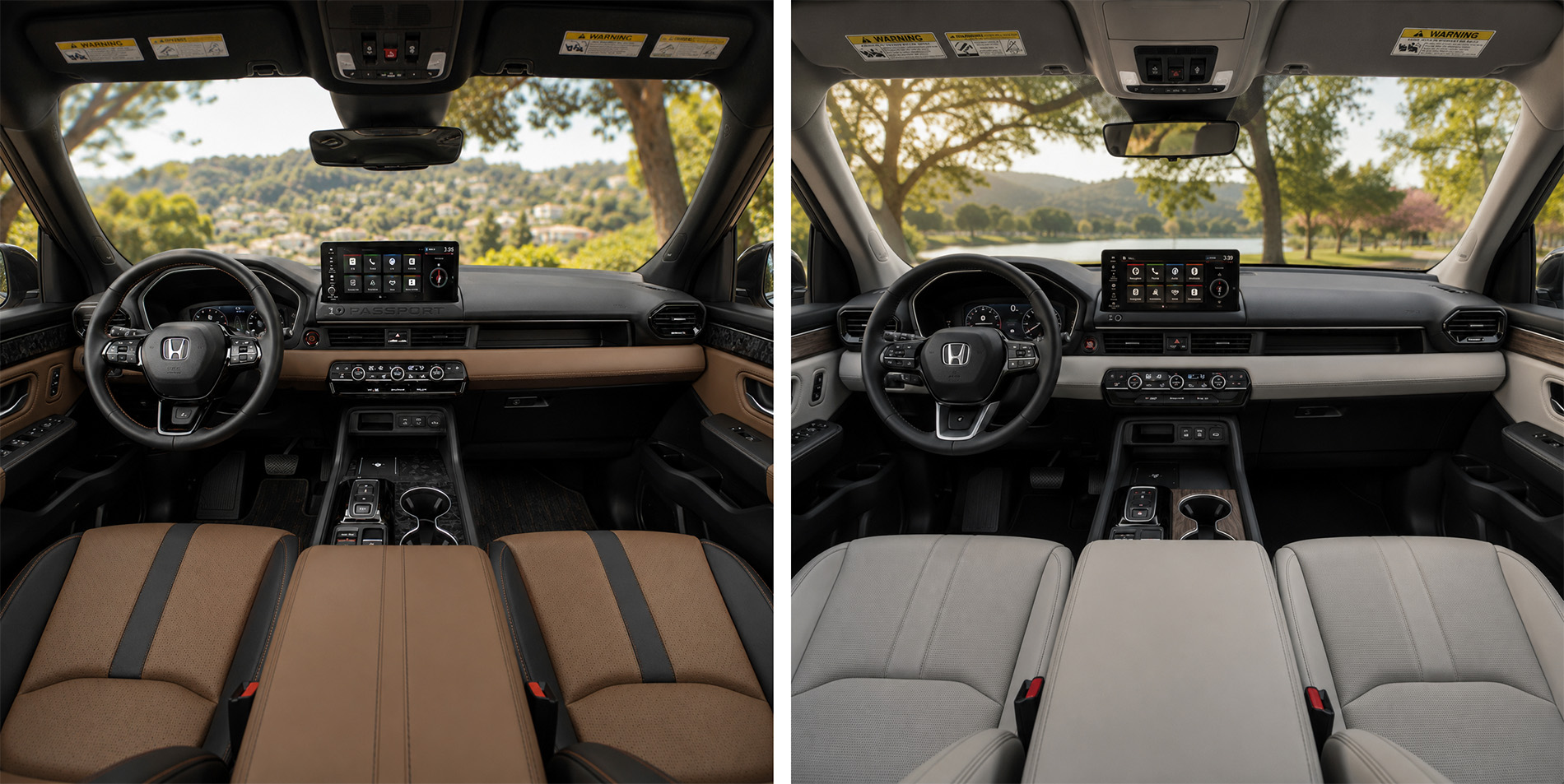
10.2-in digital instrument cluster standard
10.2-in digital instrument cluster standard Head-up display on Elite and Black Edition.
Center Touchscreen
12.3-in touchscreen standard Physical volume knob, customizable settings and smart shortcuts.
Phone & Apps
• Wireless Apple CarPlay and Android Auto • Google built-in • Wireless phone charger • Wi-Fi hotspot capability
• Wireless Apple CarPlay and Android Auto • Google built-in • Wi-Fi hotspot capability • Wireless phone charger on EX-L and above
Audio
• RTL and TrailSport: 225-watt, 9-speaker system • TrailSport Elite: 700-watt Bose 12-speaker system
• Sport: 245-watt, 9-speaker system • Touring, Elite and Black Edition: Bose 12-speaker system • Multi-zone audio on Touring and above
Camera Systems
Multi-angle rearview camera standard. Multi-View Camera System and second-generation TrailWatch on TrailSport Elite.
Rearview camera standard. TrailWatch on TrailSport; Multi-View Camera System on Touring and above.
Climate & Seating Comfort
• Tri-zone climate control standard • Heated front seats standard • Ventilated front and heated outboard rear seats on select trims
Family Convenience
Cargo bins, underfloor storage, 11 beverage holders, rear-seat reminder, and integrated rear sunshades on TrailSport Elite.
CabinTalk in-car PA capability, third-row USB charging and integrated sunshades on applicable trims, hidden cargo-well storage, and a hands-free tailgate on Touring and above.
Honda Sensing Core
CMBS, Road Departure Mitigation, ACC with Low-Speed Follow, LKAS, Traffic Jam Assist, Traffic Sign Recognition, Blind Spot Information, cross traffic monitoring, parking sensors and Low-Speed Braking Control.
CMBS, Road Departure Mitigation, ACC with Low-Speed Follow, LKAS with Traffic Jam Assist, Traffic Sign Recognition, Blind Spot Information, cross traffic monitoring and driver-attention monitoring. Additional parking support varies by trim.
Premium Direction
TrailSport Elite keeps the rugged hardware and adds the Passport’s strongest camera, seating, glass, audio and tailgate package.
Touring, Elite and Black Edition provide distinct comfort and appearance paths beyond the TrailSport role.
Technology & Comfort Takeaway
The redesigned Passport makes a strong standard-technology case and concentrates its premium upgrades in TrailSport Elite. Pilot spreads comparable technology across a wider lineup, then adds more family-specific tools and separate touring, luxury, and appearance directions.
Comparison Topic 6 of 7
Reliability, Warranty & Ownership Confidence
Current quality indicators, model-cycle maturity, shared mechanical hardware, warranty protection, maintenance support, and what can reasonably be concluded about two new 2026 SUVs
Current-model-year ratings are useful indicators, not long-term durability guarantees. J.D. Power may apply prior-year data until enough current-owner responses are available. Warranty, maintenance, and roadside-assistance terms are subject to Honda’s official documents and eligibility requirements.
All-new generation for 2026
The redesigned body, cabin electronics, suspension, AWD calibration, packaging, and related systems have less model-specific long-term owner history. That does not indicate a problem; it limits how confidently anyone can predict long-term results this early.
Current generation introduced for 2023; refreshed for 2026
The basic three-row platform and powertrain have more directly relevant real-world history, although updated electronics and features still need time to establish their record. Pilot’s platform maturity is its strongest reliability-context advantage.
Shared Mechanical Foundation
3.5-liter direct-injection V6 and 10-speed automatic transmission
• 285 hp / 262 lb-ft
• Variable Cylinder Management and idle-stop
Drivetrain Complexity
i-VTM4 AWD is standard on every trim.
Every Passport includes rear-drive hardware and AWD-related service requirements in exchange for standard traction and torque-vectoring capability.
2WD or AWD is available on Sport and EX-L; upper trims use AWD.
A 2WD Pilot omits AWD-specific hardware, while AWD Pilots align more closely with Passport in drivetrain complexity. Configuration differences do not prove that one model is more reliable.
Shared Honda Limited Warranty
• 3 years / 36,000 miles: New Vehicle Limited Warranty
• 5 years / 60,000 miles: Powertrain Limited Warranty
• 5 years / unlimited miles: Corrosion Limited Warranty
• Roadside assistance during the 3-year/36,000-mile limited-warranty term
Shared Maintenance Support
• Honda Service Pass: first year or 12,000 miles, whichever comes first
• Covers the first factory-scheduled oil and oil-filter change, tire rotation, and multi-point inspection
• Maintenance Minder alerts help time required service
Use That Can Affect Ownership Costs
Frequent trail use, towing, all-terrain tires, heavy cargo, and standard AWD make tire condition, alignment, underbody inspection, and fluid service especially important. Those are use-and-maintenance considerations, not evidence of an inherent defect.
Frequent towing, full-passenger loads, family stop-and-go use, and AWD configuration can increase wear on tires, brakes, fluids, and suspension components. How the SUV is loaded and maintained can matter more than the nameplate.
Reliability-Minded Buyer Fit
Passport fits shoppers who value its slightly higher current J.D. Power score, standard AWD, and simpler three-level equipment direction while accepting that the redesigned generation has limited long-term evidence.
Pilot fits shoppers who place more weight on a mature current-generation platform, a choice between 2WD and AWD on lower trims, and a longer directly relevant ownership record.
Reliability & Ownership Takeaway
There is no evidence-based reason to declare a universal reliability winner. J.D. Power currently gives Passport a narrow 82-to-81 Quality & Reliability edge, but Pilot counters with a more mature current-generation platform. Both use closely related V6 and 10-speed hardware and receive the same core Honda warranty, roadside-assistance term, Service Pass coverage, and Maintenance Minder support.
The practical decision is whether you are more comfortable with Passport’s all-new two-row design or Pilot’s longer current-generation history. Before delivery, review the exact vehicle’s warranty booklet, confirm any VIN-specific campaigns, and compare the maintenance demands of the chosen drivetrain, tires, towing equipment, and intended use.
Comparison Topic 7 of 7
Trim Lineups, Starting MSRP & Buyer Fit
A concentrated two-row lineup versus a broader three-row progression
Starting MSRP excludes $1,495 destination, taxes, registration, accessories, dealer charges, and premium-paint charges. Dealer prices and availability vary.
Lineup Role
2026 Honda Passport
2026 Honda Pilot
Entry & Core Trims & Starting MSRP*
• RTL — $44,950: standard AWD, Google built-in, heated seats and power tailgate • RTL Towing — $45,650: adds integrated Class III hitch and harness • RTL Blackout — $46,150: adds black wheels, badges and HPD details
• Sport — $42,395: eight seats, 2WD or AWD, Google built-in and 20-in wheels • EX-L — $44,695: leather, stowable center seat, CabinTalk and parking sensors
TrailSport Trims & Starting MSRP*
• TrailSport — $48,65:: all-terrain tires, off-road suspension, recovery hooks, skid plates and hitch • TrailSport Blackout — $49,850: adds black exterior and wheel details
• TrailSport Elite — $52,650: TrailWatch, ventilated front seats, heated rear seats, Bose audio and hands-free tailgate • TrailSport Elite Blackout — $53,850: adds black wheels, badges and HPD details
• Touring — $51,295: panoramic moonroof, Bose audio, Multi-View Camera and hands-free tailgate • Touring Blackout — $52,495: Touring equipment with black appearance package • Elite — $53,695: HUD, ventilated front seats and heated second-row seats • Black Edition — $55,195: Elite foundation with exclusive black-and-red appearance
Lineup Complexity
Three main equipment levels with towing and blackout configurations. Every choice keeps AWD, five seats and the same core two-row mission.
Six principal equipment levels plus Touring Blackout. The lineup changes drivetrain, seating, trail equipment, luxury features and appearance direction.
Value Question
The higher entry price includes AWD and a strong standard technology package. The decision is whether a dedicated two-row format is worth more than a lower-priced 2WD three-row entry point.
Pilot starts lower, but adding AWD, TrailSport hardware or upper-trim comfort changes the price quickly. Its value comes from using the extra seating and configuration range.
Best Buyer Fit
Shoppers who want to decide how rugged or premium their five-seat AWD SUV should be without changing the vehicle’s basic mission.
Shoppers who need to choose among lower-cost family utility, three-row TrailSport capability, touring comfort, luxury features or appearance-focused trims.
Trim & Pricing Takeaway
Passport keeps the shopping process focused: choose core, trail, or trail-plus-premium equipment, then decide whether towing or blackout details matter. Pilot asks more questions because its trims cover more ownership roles. The right comparison should match equivalent equipment and drivetrain, not simply the lowest MSRP in each lineup.
1 of 7
Which Honda SUV Fits Your Routine?
The best fit depends less on the shared V6 and more on who rides, what gets loaded, and how often the third row would change the day.
Choose Passport
Five Seats Cover the Whole Week
Best fit: Couples, smaller families, dog owners, and drivers who use the rear cabin for gear more often than extra passengers.
The Passport keeps its second row spacious and its cargo area ready without asking you to fold a third row first. Standard AWD also removes one configuration decision.
Choose Pilot
Passenger Needs Change Often
Best fit: Larger households, carpools, grandparents, visiting relatives, and families that regularly carry more than five people.
The third row and configurable second row give one SUV more ways to cover school runs, airport pickups, vacations, and multi-generation trips.
Choose Passport
Shorter Length and Standard AWD Matter
Best fit: East Bay drivers who want a two-row SUV that occupies less garage or curb length and includes AWD without moving up the trim range.
The Passport is 8.6 inches shorter than most Pilot trims and makes i-VTM4 AWD standard. Its additional width and larger turning circle still make a back-to-back parking test worthwhile.
Choose Pilot
One SUV Must Cover More Roles
Best fit: Buyers who want 2WD or AWD choices, seven- or eight-seat layouts, and family, trail, touring, or luxury trim directions.
Pilot TrailSport can keep the outdoor hardware while retaining three rows, while Touring, Elite, and Black Edition shift the emphasis toward comfort and technology.
Interactive Honda SUV Finder
Should You Choose the 2026 Honda Passport or Pilot?
Answer seven questions to see whether the Passport, Pilot, or both SUVs deserve a closer look based on seating, cargo, parking, AWD, TrailSport equipment, and comfort priorities.
Quiz results are general shopping guidance. Final fit depends on the exact trim, seating layout, drivetrain, equipment, inventory, pricing, and your driving routine.
Compare the Passport & Pilot at El Cerrito Honda
A back-to-back visit can settle the questions a chart cannot: second-row comfort, third-row access, cargo height, mirror clearance, camera views, steering effort, and whether the Pilot’s extra seats justify its added length.
Final Thoughts: Choose for the Day You Actually Need to Cover
The most useful question is not which SUV offers more capability on paper. It is which one handles your busiest recurring day without creating unnecessary compromises during the rest of the week. A third row has real value when it prevents regular passenger shuffling, but less value when it stays folded for nearly every trip. Likewise, a shorter two-row layout is most beneficial when easier loading, garage fit, and ready-to-use cargo space improve everyday ownership.
Use the test drive to recreate your routine instead of taking a simple loop around the block. Adjust every seat, sit in each row, load the stroller, pet crate, sports bags, or luggage you normally carry, and try the parking situations you encounter most often. Compare equivalent trims and drivetrains, then consider the full purchase—not only the starting price—including the equipment you would add, the seats you would use, and the size you would manage every day.
Choose the Passport when its five-seat layout solves your real needs with less unused vehicle. Choose the Pilot when the third row meaningfully expands what your household can do. The right decision is the model that makes your demanding days easier without asking you to carry space, cost, or complexity that rarely serves a purpose.
FAQ: 2026 Honda Passport vs Honda Pilot
Is the 2026 Honda Passport smaller than the Honda Pilot?▼
Yes. The Passport is 191.5 inches long, while most Pilot trims are 200.1 inches long. The Passport is slightly wider, so shoppers should compare both length and mirror clearance.
Does the Honda Passport have a third row?▼
No. The Passport is a two-row SUV with seating for five. The Pilot is the Honda choice when a third row is required.
How many people do the Passport and Pilot seat?▼
The Passport seats five. The Pilot seats seven or eight, depending on whether the selected trim uses captain’s chairs or a second-row bench.
Which has more cargo space?▼
The Passport provides 44.0 cubic feet behind its second row. The Pilot provides cargo room behind its third row and a higher maximum when both rear rows are folded. The better layout depends on whether passengers or a permanently open cargo area matter more.
Which Honda SUV is easier to park?▼
The Passport occupies less length, which helps in shorter garages and curb spaces. The Pilot is slightly narrower and has a marginally tighter listed turning diameter. A back-to-back parking test is the most useful comparison.
How do Passport TrailSport and Pilot TrailSport differ?▼
Both add AWD, all-terrain tires, skid plates, off-road-tuned suspension, and integrated hitch equipment. Passport TrailSport adds front and rear recovery hooks and keeps a two-row cargo-focused layout. Pilot TrailSport retains three rows, uses second-row captain’s chairs, and includes TrailWatch.
How do Passport and Pilot towing capacities compare?▼
The Passport is rated to tow up to 5,000 pounds when properly equipped. AWD Pilot configurations can also reach 5,000 pounds, while 2WD Pilot configurations have a lower limit. Always verify the exact vehicle and owner’s manual.
Should a family choose the Passport or Pilot?▼
A family that rarely carries more than five people may find the Passport more focused and easier to justify. A family that regularly carries friends, relatives, or carpool passengers should begin with the Pilot.
Shop & Service with El Cerrito Honda
At El Cerrito Honda, we believe choosing a vehicle should begin with a conversation about how you actually drive. As a family-owned and operated dealership with more than 50 years of local history, we have built our business around long-term relationships rather than one-time transactions. Our privately held, locally focused approach allows us to serve East Bay drivers with straightforward guidance, personal attention, and support that continues well after the purchase.
Our sales team can help you compare Passport and Pilot inventory by seating layout, drivetrain, TrailSport equipment, comfort features, price, and current availability without reducing the decision to a list of specifications. Online financing tools make it easier to begin the process from home, while an in-person visit lets you evaluate the details that matter most: second-row comfort, third-row access, cargo loading, visibility, garage fit, and which trim best supports your commute or family routine.
Our relationship with you does not end when you leave the showroom. El Cerrito Honda provides a convenient destination for routine maintenance, certified Honda service, and ongoing ownership support, helping you keep your vehicle prepared for commuting, family travel, towing, and weekend use. From the first comparison through future service visits, our goal is to remain your one-stop Honda resource for El Cerrito, Contra Costa County, and the wider East Bay.
Located at 11755 San Pablo Avenue, we are convenient for drivers traveling the I-80 corridor from Berkeley, Richmond, San Pablo, Pinole, and nearby communities. Whether you are shopping for a new Honda, exploring financing, valuing a trade, or scheduling maintenance, our team is here to provide clear answers and a more personal dealership experience.
Where To Go Next
Continue researching the 2026 Passport and Pilot, then compare live inventory, current Honda offers, financing, and trade-value options through El Cerrito Honda.
Disclaimers:
*MSRP excludes tax, license, registration, $1,495 destination charge, accessories, and dealer charges. Premium colors may cost extra. Dealer prices and availability may vary. *EPA fuel-economy ratings vary by trim and drivetrain. Actual mileage will vary with driving conditions, vehicle condition, loading, accessories, and driving habits. *Cargo measurements use manufacturer methods and may include floor-space, underfloor, or maximum-volume calculations. Compare like-for-like measurements and inspect the cargo areas in person. *Towing capacity depends on drivetrain, equipment, passengers, cargo, hitch hardware, tongue weight, and other factors. See the owner’s manual and vehicle documentation before towing. *Honda Sensing and camera systems are driver-assist features and do not replace attentive driving. System operation is affected by speed, weather, road conditions, visibility, and other factors. *Warranty, roadside-assistance, and Honda Service Pass coverage are subject to Honda’s official terms, mileage and time limits, eligibility requirements, maintenance indicators, and exclusions. Confirm coverage in the current warranty booklet and vehicle documentation. *J.D. Power Quality & Reliability scores are current as of publication, may incorporate prior-model-year data when current-owner data is limited, and do not guarantee future durability. *Third-party ratings, rankings, and awards were current when reviewed and can change. Car and Driver and J.D. Power are not affiliated with El Cerrito Honda or American Honda Motor Co., Inc.