Compare the 2026 Honda CR-V vs Toyota RAV4
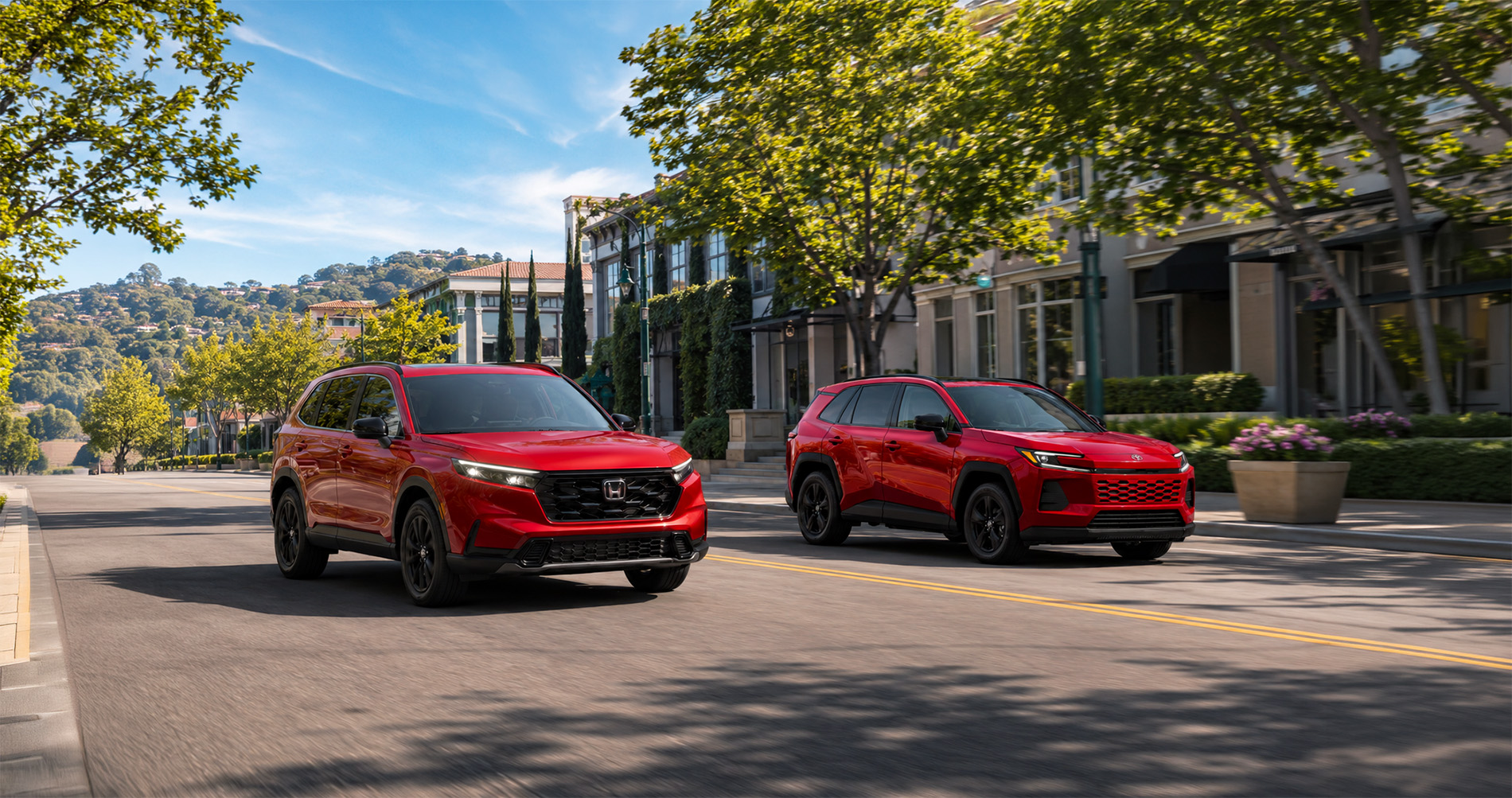
Two red SUVs—a 2026 Honda CR-V and a 2026 Toyota RAV4—driving side by side through downtown El Cerrito, California, with tree-lined streets, modern storefronts, and hills in the distance, emphasizing their sporty design and urban versatility.


2026 Honda CR-V vs. 2026 Toyota RAV4

Compact-SUV Space, Hybrid Efficiency & the Gas-or-Electrified Decision


The 2026 Honda CR-V vs Toyota RAV4 decision is not a simple winner-and-loser comparison. These compact SUVs now answer different ownership priorities. The CR-V gives shoppers a choice between a 190-horsepower turbocharged gas model and a 204-horsepower two-motor hybrid, while the redesigned 2026 RAV4 moves into a 100% electrified lineup with Hybrid and Plug-in Hybrid models, strong MPG estimates, available Electronic On-Demand All-Wheel Drive, and a more capability-forward Woodland trim.

The RAV4 deserves credit for making the electrified decision easier. If you already know you want hybrid or plug-in hybrid efficiency, Toyota puts that idea at the center of the RAV4 lineup, with trims that range from efficient LE and SE models to the rugged Woodland. The RAV4 also has the stronger utility story for shoppers who will use its Woodland equipment or select AWD configurations for more than just commuting.

The CR-V takes a different approach. It works better for shoppers who want to decide whether hybrid power is worth the price step, while keeping the CR-V’s roomy cabin, easy daily drivability, available Real Time AWD, and broad family-friendly cargo flexibility. For East Bay drivers moving between I-80, I-580, Highway 24, neighborhood errands, and longer Bay Area drives, the better choice depends on whether you prioritize maximum MPG and electrified utility or cabin space, comfort, price flexibility, and everyday ease.
 

Quick Answers 2026 Honda CR-V vs Toyota RAV4

What is the basic CR-V vs RAV4 difference?
The CR-V is the more flexible choice because it offers both gas and hybrid trims. The 2026 RAV4 is the more electrified-focused choice, with Hybrid and Plug-in Hybrid models, strong MPG estimates, available AWD, and a redesigned lineup built around fuel-saving technology.


Which SUV costs less to start?
The 2026 Honda CR-V LX starts at $30,920 MSRP, while the 2026 Toyota RAV4 LE starts at $31,900 MSRP. The important context is that the CR-V LX is gas-powered, while the RAV4 LE starts Toyota’s electrified RAV4 lineup.


Which one is more efficient?
The RAV4 has the stronger MPG ceiling among non-plug-in hybrid models, with Toyota listing up to an estimated 47 city / 40 highway MPG on select trims. Honda lists up to 43 city / 36 highway MPG for the CR-V Hybrid.


Does the 2026 Honda CR-V still offer a non-hybrid model?
Yes. The 2026 CR-V lineup includes gas trims such as LX, EX, and EX-L, plus hybrid trims such as Sport Hybrid, TrailSport Hybrid, Sport-L Hybrid, and Sport Touring Hybrid.


Which SUV has the stronger rugged trim?
Both brands now have a rugged-leaning hybrid trim. The CR-V TrailSport Hybrid gives Honda shoppers Real Time AWD, all-terrain tires, TrailSport styling, all-weather cabin details, and CR-V hybrid efficiency. The RAV4 Woodland counters with AWD, all-terrain tires, Woodland roof rails with crossbars, Rigid Industries LED fog lights, a tow hitch, and a more utility-focused equipment set.


Which should East Bay shoppers test drive first?
Start with the CR-V if cabin comfort, cargo flexibility, daily commuting, and gas-or-hybrid choice matter most. Start with the RAV4 if your priorities are maximum MPG, plug-in availability, and Toyota’s more capability-forward Woodland trim.


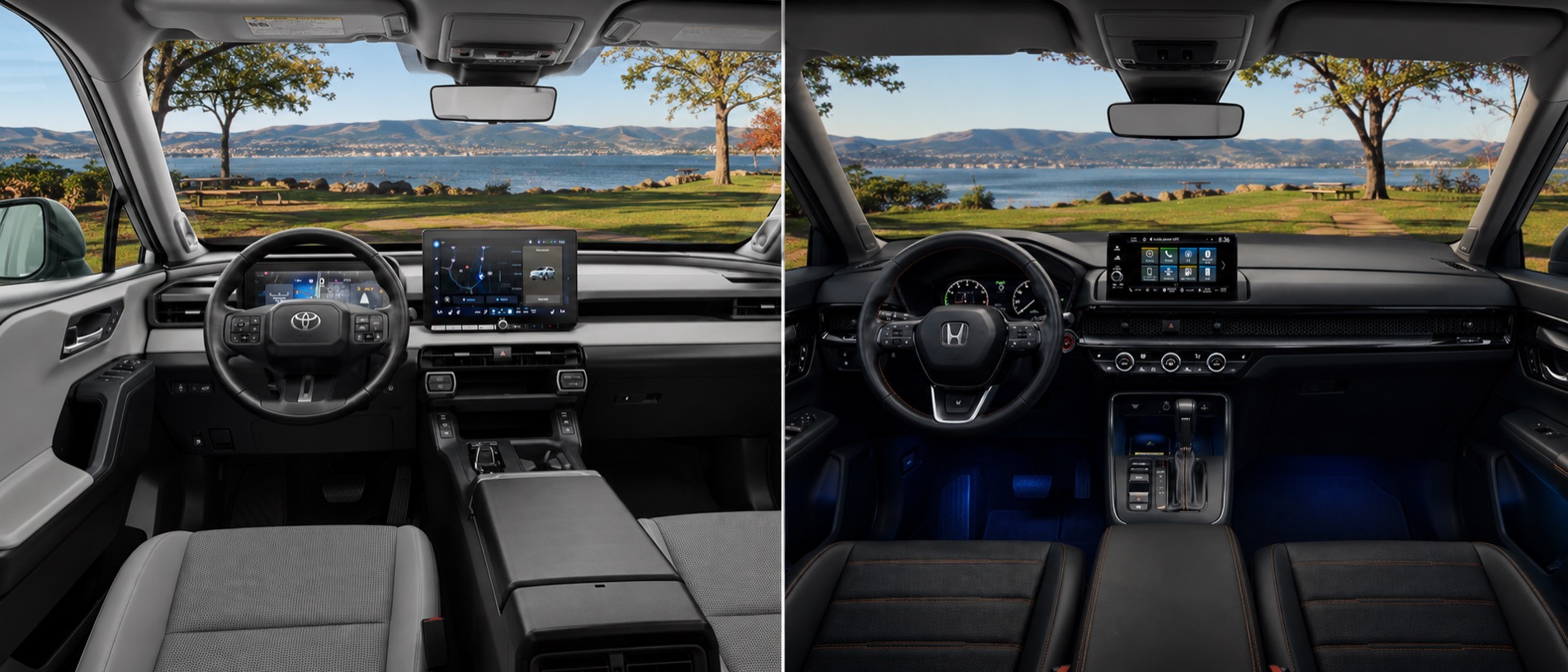
Side-by-side view of the 2026 Toyota RAV4 and 2026 Honda CR-V interiors parked near a lakeside park in El Cerrito, California, showing both dashboards and steering wheels with scenic water and hills in the background. The Toyota cabin features a large vertical touchscreen and angular design, while the Honda interior highlights a horizontal display, circular climate controls, and blue ambient lighting.


Core Differences: 2026 Honda CR-V vs. 2026 Toyota RAV4

The table below focuses on ownership differences that actually shape the decision: price, powertrain strategy, MPG, AWD availability, cargo usefulness, rugged-trim positioning, utility equipment, and each SUV’s strongest argument. It is not meant to replace a full trim-by-trim build sheet.


2026 Honda CR-V vs 2026 Toyota RAV4 Key Differences
Category 2026 Honda CR-V 2026 Toyota RAV4
Highlighted differences only — not a complete list of all features, specifications, options, packages, accessories, fees, incentives, or availability details.
Starting MSRP* Trim: CR-V LX
Starting MSRP: $30,920*
Gas-powered entry point
Trim: RAV4 LE
Starting MSRP: $31,900*
Hybrid-powered entry point
Lowest Hybrid Starting MSRP* Trim: CR-V Sport Hybrid
Starting MSRP: $35,630*
First step into CR-V hybrid power
Trim: RAV4 LE Hybrid
Starting MSRP: $31,900*
Hybrid power starts at the base trim
Powertrain Strategy Gas option:
• 190-hp turbocharged gas engine on select trims
Hybrid option:
• 204-hp two-motor hybrid powertrain on hybrid trims
Best for shoppers who want gas-or-hybrid choice.
Lineup approach:
• 100% electrified lineup
• Hybrid and Plug-in Hybrid models
RAV4 Hybrid output:
• 226 hp FWD
• 236 hp AWD
Best for shoppers who already want electrified power.
Best MPG Highlight* Select CR-V Hybrid trims:
• Up to 43 city MPG
• Up to 36 highway MPG
Strong efficiency while keeping Honda’s roomy compact-SUV layout.
Select RAV4 Hybrid trims:
• Up to 47 city MPG
• Up to 40 highway MPG
Stronger headline hybrid MPG estimate.
AWD Availability System: Real Time AWD
Availability: Available on many trims
Standard on: TrailSport Hybrid and Sport Touring Hybrid
System: Electronic On-Demand AWD
Availability: FWD or AWD depending on trim
Standard on: Woodland
Cargo Space Highlight* Maximum cargo:
• Up to 76.5 cu. ft.
Everyday cargo usability:
• Low, wide cargo opening
• Reclining, fold-down 60/40 split rear seatback
CR-V has the stronger space-and-loading case.
Maximum cargo:
• Up to 70.4 cu. ft.
Still practical, but not the main RAV4 advantage.
Rugged-Leaning Hybrid Trim CR-V TrailSport Hybrid:
• Real Time AWD
• All-terrain tires
• TrailSport styling
• All-weather floor mats
• 10.2-inch digital instrument cluster
• Hybrid power
• 8.2 inches of ground clearance
Rugged-leaning Honda daily driver.
RAV4 Woodland:
• AWD
• All-terrain tires
• Woodland roof rails with crossbars
• Rigid Industries LED fog lights
• Tow hitch
• 8.5 inches of ground clearance
More capability-forward rugged hybrid.
Light Utility Note* Honda ratings:
• Up to 1,500 lbs. on gas CR-V trims
• Up to 1,000 lbs. on CR-V Hybrid trims
Best understood as light utility, not a towing-first compact SUV.
Toyota utility highlight:
• Up to 3,500 lbs. on select AWD configurations
Useful for shoppers who will actually use the added capability.
Primary Advantage Strongest for shoppers who want:
• Gas-or-hybrid choice
• Everyday comfort
• Useful cargo flexibility
• A well-rounded compact-SUV feel
Best fit when daily livability leads the decision.
Strongest for shoppers who want:
• Electrified simplicity
• Stronger MPG ceiling
• Plug-in Hybrid availability
• More capability-forward Woodland trim
Best fit when efficiency and utility lead the decision.

What the Core Differences Mean

The RAV4 has the cleaner efficiency-and-capability pitch. Toyota makes electrified power central to the lineup, publishes a stronger hybrid MPG ceiling, offers Plug-in Hybrid availability, and gives shoppers a clear outdoors-oriented step with the Woodland trim. That matters if you want your compact SUV decision to start with fuel economy, AWD confidence, and trailhead-friendly equipment.

The CR-V answers with broader everyday flexibility. It starts lower with a gas model, then lets shoppers move into hybrid power if fuel savings and smoother electrified driving are worth the price step. That choice matters for buyers who want a compact SUV that can handle commuting, family errands, school schedules, grocery runs, and weekend cargo without being locked into one powertrain strategy.

The rugged-trim comparison is useful, but it should stay in context. RAV4 Woodland is the stronger choice for shoppers who will actually use its tow hitch, raised Woodland equipment, all-terrain tires, and outdoor-utility details. CR-V TrailSport Hybrid is better framed as the rugged-leaning Honda daily driver: more dirt-road and bad-weather attitude than a standard CR-V Hybrid, but still centered on hybrid efficiency, cabin comfort, and normal East Bay ownership.
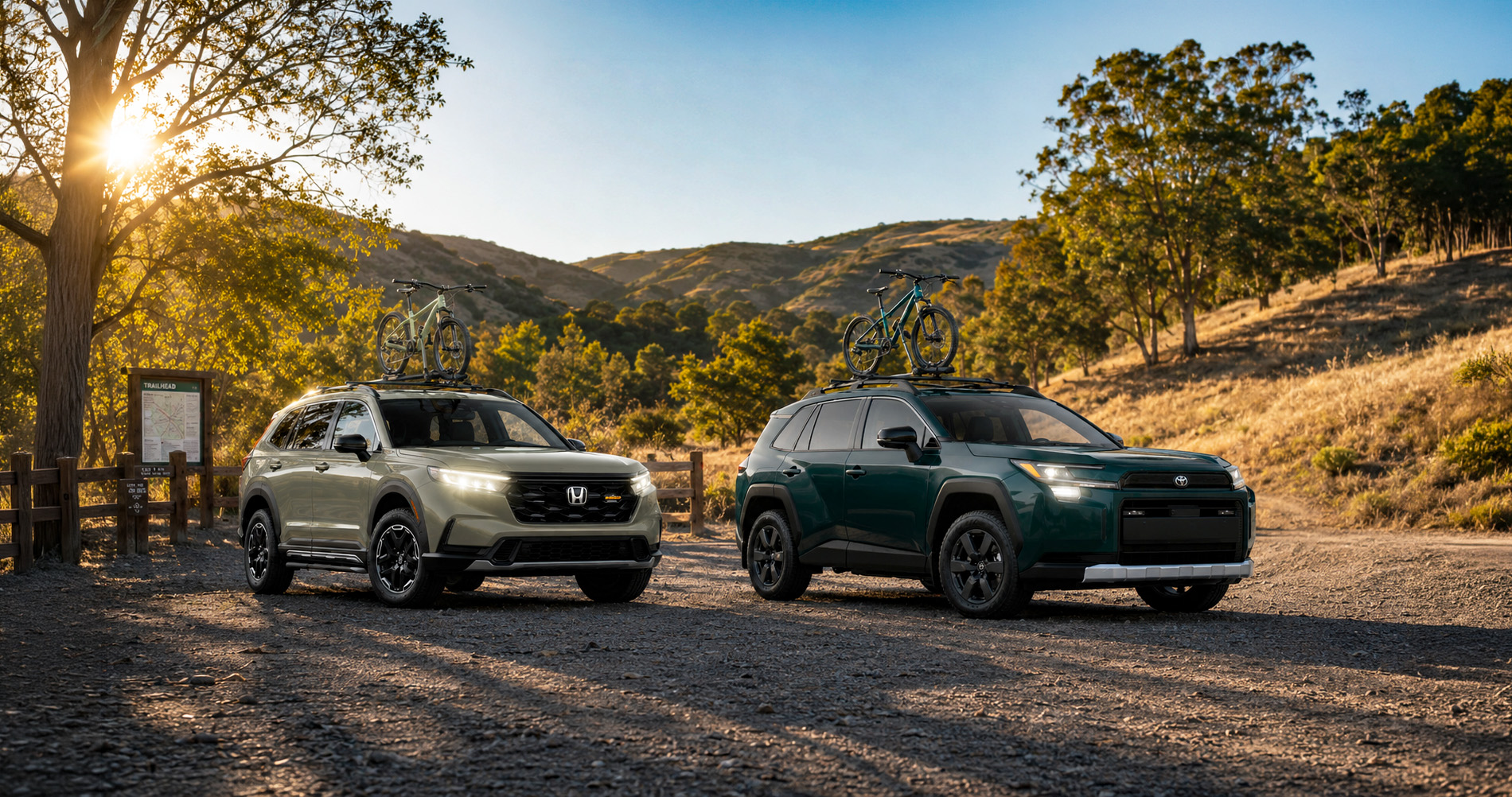
 

A light green 2026 Honda CR-V and a dark green 2026 Toyota RAV4 parked side by side near a trailhead in El Cerrito, California, each equipped with roof-mounted bicycles, surrounded by trees and rolling hills under warm evening sunlight, highlighting their outdoor-ready utility and weekend adventure appeal.


What Each Compact SUV Does Best

The CR-V and RAV4 are close enough in size and purpose that the right answer depends on use. Giving each SUV its own role makes the comparison more useful than forcing one universal winner.


2026 Honda CR-V

The flexible everyday compact SUV

Best Fit: Shoppers who want a roomy, easy-to-live-with SUV and the choice between lower-entry gas trims and more efficient hybrid trims.


The CR-V is strongest when daily ownership matters more than the highest MPG number or maximum utility rating. It gives East Bay drivers a practical balance of seating comfort, cargo flexibility, available AWD, hybrid availability, and a gas-model entry point that keeps the first step into the lineup more flexible.

2026 Toyota RAV4

The electrified efficiency and utility play

Best Fit: Shoppers who want hybrid or PHEV efficiency built into the decision from the start, plus a more utility-focused lineup.


The RAV4 makes the most sense when MPG, AWD utility, electrified driving, and rugged-trim equipment sit higher on the priority list. Its advantage is not that it makes the CR-V irrelevant; it simply serves a different buyer who wants the compact SUV to lean harder into efficiency and weekend capability.


Compare the 2026 CR-V & 2026 RAV4 by What Matters Most

The CR-V vs RAV4 comparison works best when each section answers a specific ownership question. Pricing explains how each lineup is structured. MPG and powertrain details explain fuel use and daily driving. Cargo, AWD, technology, safety, and rugged-trim equipment show which differences matter beyond the spec sheet.


Lineup, Trims & Pricing CR-V flexibility vs RAV4 electrified simplicity
2026 Honda CR-V vs 2026 Toyota RAV4 Trim & Pricing Overview
Category 2026 Honda CR-V 2026 Toyota RAV4 Shopper Meaning
Highlighted trims only — not a complete list of all equipment, options, packages, accessories, fees, incentives, or availability details.
Entry Point Trim: LX
Starting MSRP: $30,920*
Powertrain: Gas
Trim: LE
Starting MSRP: $31,900*
Powertrain: Hybrid
CR-V advantage: Lower starting MSRP
RAV4 advantage: Hybrid power from the start
The better value depends on whether you already planned to buy a hybrid.
First Hybrid Step Trim: Sport Hybrid
Starting MSRP: $35,630*
Trim: LE Hybrid
Starting MSRP: $31,900*
RAV4 starts with hybrid power
RAV4: Lower hybrid entry point
CR-V: Lets shoppers stay gas or step up to hybrid
This matters most if monthly payment and hybrid value are being weighed together.
Comfort-Focused Trims EX: $33,150*
EX-L: $35,400*
Sport-L Hybrid: $38,725*
SE: $34,700*
XLE Premium: $36,100*
XSE: $41,300*
Compare the specific trims you are considering by:
• Seat materials
• Liftgate features
• Screen size
• AWD needs
• MPG and monthly payment
Rugged-Leaning Hybrid Trim Trim: TrailSport Hybrid
Starting MSRP: $38,800*
AWD: Real Time AWD
Tires: All-terrain
Trim: Woodland
Starting MSRP: $39,900*
AWD: Standard
Tires: All-terrain
Utility: Tow hitch
CR-V TrailSport Hybrid: Rugged Honda daily driver
RAV4 Woodland: More capability-forward rugged hybrid
Woodland has the stronger case if outdoor utility and trim-specific equipment are central to the purchase.
Top Trim Trim: Sport Touring Hybrid
Starting MSRP: $42,550*
Drivetrain: AWD
Audio: Bose premium audio
Tech: Google built-in
Trim: Limited
Starting MSRP: $43,300*
Efficiency: Manufacturer-estimated 42 combined MPG on Limited AWD
Audio: JBL premium audio
Charging: Dual Qi wireless charging
CR-V: Honda comfort, Bose audio, Google built-in
RAV4: Newer Toyota digital-cabin package
Both are aimed at shoppers who want the most complete cabin experience.

Pricing & Lineup Meaning

The CR-V is easier to justify if you want flexibility before committing to hybrid ownership. A shopper can start with the gas LX or EX, move into the EX-L for leather-trimmed comfort, or step into one of the hybrid trims when fuel economy, stronger electrified response, or TrailSport/Sport Touring equipment becomes the priority.

The RAV4 is easier to understand if the electrified decision has already been made. Toyota does not make shoppers sort through a gas-versus-hybrid split in the same way. Instead, the RAV4 lineup asks whether you want value, sportier styling, premium comfort, Woodland capability, Limited-level equipment, or Plug-in Hybrid performance and range.

The shopper-facing takeaway is simple: CR-V starts with more powertrain choice, while RAV4 starts with a lower hybrid entry point. That is why the better price story depends on what you intended to buy in the first place.

Performance, MPG & Hybrid Driving RAV4 MPG strength vs CR-V powertrain choice
2026 CR-V vs 2026 RAV4 Performance & MPG
Category 2026 Honda CR-V 2026 Toyota RAV4
EPA and manufacturer estimates vary by trim, drivetrain, road conditions, driving style, and vehicle load.
Gas Powertrain Engine: 1.5-liter turbocharged 4-cylinder
Horsepower: 190 hp
Torque: 179 lb-ft
Transmission: CVT
Gas-only model: Not offered for 2026
Lineup focus: Hybrid and Plug-in Hybrid models
Toyota centers the redesigned RAV4 around electrified power.
Hybrid Powertrain Engine: 2.0-liter 4-cylinder
Hybrid system: Two-motor hybrid
Total system output: 204 hp
Electric motor: 181 hp / 247 lb-ft motor torque
Engine: 2.5-liter Dynamic Force 4-cylinder hybrid system
FWD output: 226 hp
AWD output: 236 hp
Transmission: Electronically controlled CVT
Plug-in Hybrid Availability CR-V Plug-in Hybrid: Not offered
CR-V shoppers choose between gas and hybrid trims.
RAV4 Plug-in Hybrid: Available in the redesigned 2026 lineup
Buyer role: Additional electrified step above the standard hybrid
Useful for shoppers who want more electrified driving flexibility.
Best MPG Highlight* 2WD CR-V Hybrid trims:
• 43 city MPG
• 36 highway MPG
• 40 combined MPG
Select FWD RAV4 Hybrid trims:
• 47 city MPG
• 40 highway MPG
• 43 combined MPG
AWD Hybrid MPG Examples* Many AWD hybrid trims:
• 40 city / 34 highway / 37 combined MPG
TrailSport Hybrid:
• 38 city / 33 highway / 35 combined MPG
LE AWD and SE AWD:
• 45 city / 39 highway / 42 combined MPG
Woodland AWD:
• 41 city / 35 highway / 38 combined MPG
Driving Priority • Balanced daily comfort
• Lower-entry gas option
• Smoother hybrid efficiency available
Best when flexibility matters as much as MPG.
• Stronger hybrid MPG estimates
• More electrified options
• Plug-in Hybrid availability
Best when efficiency leads the decision.

Efficiency & Daily Driving Meaning

The RAV4 wins the headline efficiency comparison among standard hybrid models. Its highest MPG estimates are stronger than the CR-V Hybrid’s, and its AWD hybrid ratings remain strong across much of the lineup. The addition of Plug-in Hybrid models gives Toyota another advantage for shoppers who want more electrified driving options.

The CR-V counters by giving shoppers more control over the decision. The gas CR-V keeps the entry price lower and works well for drivers who want a compact SUV without paying for hybrid hardware. The CR-V Hybrid becomes the better Honda fit when fuel economy, smoother low-speed response, and a more relaxed commuting feel become priorities.

For East Bay driving, the difference shows up in use patterns. Drivers who spend long stretches on I-80, I-580, or Highway 24 may care most about the RAV4’s MPG advantage. Drivers balancing shorter errands, family stops, parking, and weekend cargo may find the CR-V’s comfort and powertrain choice more useful across a normal week.

Interior Space, Seating & Cargo Room Where CR-V makes its strongest everyday case
2026 CR-V vs 2026 RAV4 Interior & Cargo Measurements
Measurement 2026 Honda CR-V 2026 Toyota RAV4
Cargo and passenger measurements vary by trim, moonroof, hybrid components, drivetrain, and equipment.
Seating Capacity 5 passengers 5 passengers
Passenger Volume Up to: 106.0 cu. ft.
One of the CR-V’s strongest everyday advantages.
Total: 98.9 cu. ft.
Still practical, but not as roomy on paper.
Front / Rear Legroom Front: 41.3 in.
Rear: 41.0 in.
Front: 41.0 in.
Rear: 37.8 in.
Cargo Behind Second Row CR-V gas trims:
• Up to 39.3 cu. ft.
CR-V Hybrid trims:
• 36.3 cu. ft.
Behind second row: 37.8 cu. ft.
Practical for groceries, bags, and daily cargo.
Maximum Cargo Volume CR-V gas trims:
• Up to 76.5 cu. ft.
CR-V Hybrid trims:
• 71.8 cu. ft.
Maximum cargo: 70.4 cu. ft.

Passenger Comfort & Cargo Use

The CR-V makes its strongest everyday case inside. Its rear legroom advantage is meaningful, especially when taller front-seat passengers still leave space behind them. That matters during family errands, carpooling, longer East Bay drives, or weekends when adults use the second row instead of children.

Cargo space depends on configuration, but the CR-V remains one of the easier compact SUVs to live with for bulky daily items. The gas CR-V has the larger maximum cargo figure, while the CR-V Hybrid gives up some cargo volume to hybrid packaging but still keeps a useful load area for groceries, backpacks, luggage, sports bags, and folded-seat flexibility.

The RAV4 is not cramped, and its cargo space remains practical for normal compact-SUV use. Its advantage is not maximum interior room; it is the combination of electrified efficiency, AWD utility, and capability-oriented trims. Shoppers who frequently carry rear passengers or compare cargo layouts in person should give the CR-V a close look.

AWD, Rugged-Trim Utility & Light Trailhead Use CR-V TrailSport Hybrid vs RAV4 Woodland
2026 CR-V vs 2026 RAV4 AWD & Rugged Utility
Category 2026 Honda CR-V 2026 Toyota RAV4
Capability, utility, and ratings vary by configuration and require proper equipment, safe loading, and owner manual verification.
AWD System System: Real Time AWD with Intelligent Control System
Availability: Available on many trims
Standard on: TrailSport Hybrid and Sport Touring Hybrid
System: Electronic On-Demand All-Wheel Drive
Availability: Available on multiple trims
Standard on: Woodland
Rugged Hybrid Trim CR-V TrailSport Hybrid:
• Real Time AWD
• All-terrain tires
• 18-inch Shark Gray alloy wheels
• TrailSport cabin details
• All-weather floor mats
• Heated steering wheel
RAV4 Woodland:
• AWD
• All-terrain tires
• Woodland raised black roof rails with crossbars
• Rigid Industries LED fog lights
• Tow hitch
• 8.5 inches of ground clearance
Light Utility Ratings* Gas trims: 1,500 lbs.
Hybrid trims: 1,000 lbs.
Best framed as light utility, not a towing-first SUV.
LE FWD/AWD and select FWD trims: 1,750 lbs.
Woodland, XLE Premium AWD, SE AWD, XSE AWD, Limited AWD: 3,500 lbs.
Stronger utility rating for shoppers who will use it.
Ground Clearance Up to: 8.2 inches on AWD trims
TrailSport Hybrid role: AWD plus all-terrain tires for rough-road confidence
Most grades: 8.1 inches
Woodland: 8.5 inches
Woodland has the stronger ground-clearance figure.
Best Use Case Best for shoppers who want:
• Rugged-looking AWD hybrid trim
• Daily comfort
• Cargo flexibility
• Commuting ease
Best for shoppers who want:
• Adventure-utility equipment
• Woodland hardware beyond appearance
• More capability-forward trim identity
• A stronger setup for weekend gear

TrailSport Hybrid vs Woodland

The RAV4 has the stronger capability case. Woodland trim adds equipment that supports the outdoors-oriented pitch: all-terrain tires, raised roof rails with crossbars, Rigid Industries LED fog lights, a tow hitch, and extra ground clearance. Shoppers who prioritize weekend utility should give the RAV4 Woodland real credit.

The CR-V TrailSport Hybrid gives Honda shoppers a rugged-leaning trim path with a different mission. TrailSport Hybrid adds Real Time AWD, all-terrain tires, Shark Gray wheels, TrailSport interior details, all-weather mats, a heated steering wheel, a power tailgate, parking sensors, and the CR-V Hybrid powertrain.

The difference is not whether one trim exists and the other does not. Both exist. The question is how you plan to use them. Choose RAV4 Woodland if capability equipment is central to the purchase. Choose CR-V TrailSport Hybrid if you want a more rugged Honda hybrid for rain, rough pavement, gravel lots, weekend gear, and everyday East Bay driving.

Technology, Connectivity & Cabin Ease Simple Honda usability vs redesigned Toyota screen tech
2026 CR-V vs 2026 RAV4 Technology Highlights
Category 2026 Honda CR-V 2026 Toyota RAV4
Feature availability varies by trim, package, connected-service requirements, smartphone compatibility, and subscription status.
Main Touchscreen Screen size: 9-inch color touchscreen
Availability: Across the CR-V lineup
Simple, familiar Honda interface.
Standard / common screen: 10.5-inch Toyota Audio Multimedia on many trims
Upper trims: 12.9-inch Toyota Audio Multimedia available or standard
Stronger screen-size story.
Digital Cluster Select trims: 7-inch TFT meter display
Higher trims: 10.2-inch digital instrument cluster
Standard: 12.3-inch customizable digital gauge cluster
A clear Toyota tech advantage on paper.
Smartphone Integration • Wireless Apple CarPlay compatibility
• Wireless Android Auto compatibility
• Wireless Apple CarPlay compatibility
• Wireless Android Auto compatibility
Premium Tech / Audio Sport Touring Hybrid highlights:
• Google built-in
• Bose 12-speaker premium sound system
Available / upper-trim highlights:
• JBL premium audio
• 12.9-inch touchscreen
• Dual Qi wireless chargers
• 1500W AC outlet
Daily Use Character • Straightforward cabin layout
• Familiar controls
• Quick daily-use tech flow
Best if ease matters more than screen size.
• Fresher digital-cabin story
• Larger available screens
• More redesigned technology content
Best if the newest interface is a priority.

Tech That Fits the Way You Drive

The RAV4 has the more dramatic technology story because it is the newer redesign. Its standard 12.3-inch digital gauge cluster, available 12.9-inch multimedia display, available dual wireless chargers, available 1500W AC outlet, and Drive Recorder Dash Cam help the Toyota feel more feature-forward on paper.

The CR-V focuses on clean daily usability. A 9-inch touchscreen, wireless smartphone integration, available 10.2-inch digital instrument cluster, available Google built-in, and available Bose audio give shoppers the key technology pieces without making the cabin feel overly complex. That matters for drivers who want navigation, phone, music, and climate routines to stay easy during commuting and errands.

Shoppers should compare the exact trims they are considering. The RAV4 may appeal more if large screens and redesigned tech are high priorities. The CR-V may feel more natural if easy controls, familiar Honda cabin logic, and a quieter daily-use experience matter more than having the largest available display.

Safety & Driver Assistance Strong standard foundations, trim-specific upgrades
2026 CR-V vs 2026 RAV4 Safety & Driver-Assistance Highlights
Category 2026 Honda CR-V 2026 Toyota RAV4
Driver-assistance systems are support features. They do not replace attentive driving, safe speeds, visual checks, or driver control.
Safety Suite Suite: Honda Sensing
Role: Standard driver-assistive technology foundation
Suite: Toyota Safety Sense 4.0
Role: Redesigned RAV4 driver-assistance foundation
Common Driver-Assist Focus Includes features such as:
• Collision Mitigation Braking System
• Road Departure Mitigation
• Adaptive Cruise Control with Low-Speed Follow
• Lane Keeping Assist
• Traffic Jam Assist
• Traffic Sign Recognition
• Driver attention support
Toyota highlights:
• Toyota Safety Sense 4.0
• Available Traffic Jam Assist
• Available Advanced Park
• Additional package-dependent driver-assist features
Availability depends on trim, package, and connected-service requirements.
Blind-Spot / Parking Support Availability varies by trim for:
• Blind Spot Information
• Cross Traffic Monitor
• Parking sensors
• Low-Speed Braking Control
Availability varies by trim and package for:
• Blind-spot features
• Parking support
• Camera systems
• Advanced convenience features

Safety Comparison Meaning

Both SUVs give shoppers a strong driver-assistance foundation, so this section should not be turned into a forced win. The better comparison is trim-specific. CR-V shoppers should look at which Honda Sensing features and parking/awareness systems are included on the exact trim they plan to buy. RAV4 shoppers should do the same with Toyota Safety Sense 4.0, available Traffic Jam Assist, Advanced Park, and other package-dependent systems.

The practical takeaway is that neither SUV removes the need for attentive driving. These systems support awareness, following-distance management, lane guidance, and low-speed convenience in the right conditions. They are helpful, but they are not a substitute for checking mirrors, watching traffic, adjusting to weather, and staying in control.


Which Compact SUV Fits Your Routine?

The 2026 Honda CR-V vs Toyota RAV4 decision should come down to how you actually use a compact SUV. The CR-V is stronger for shoppers who want daily comfort, passenger space, cargo flexibility, and the choice between gas and hybrid power. The RAV4 is stronger for shoppers who want an electrified lineup, Plug-in Hybrid availability, and a more utility-forward trim structure.


Choose the CR-V Gas Trims If...

You want space and comfort without hybrid pricing.

Best Fit: Shoppers who want a practical compact SUV with a lower entry point, roomy seating, useful cargo space, and available AWD without committing to a hybrid.


The gas CR-V trims make sense if your week is built around commuting, errands, family schedules, and normal East Bay driving. You still get the CR-V cabin and cargo advantages, while keeping the initial price lower than the first CR-V Hybrid trim.

Choose the CR-V Hybrid If...

You want Honda practicality with fewer fuel stops.

Best Fit: Drivers who like the CR-V’s roomy cabin, relaxed driving feel, and flexible cargo area but want better MPG than the gas model.


The CR-V Hybrid is the balanced Honda answer in this comparison. It does not chase the RAV4’s highest hybrid MPG or utility figures, but it gives commuters and families a smoother, more efficient CR-V without giving up the everyday comfort that makes the Honda easy to live with.

Choose the RAV4 Hybrid or PHEV If...

You want the electrified decision built in.

Best Fit: Shoppers who prioritize MPG, Toyota’s electrified lineup strategy, a lower hybrid entry point than the CR-V Hybrid, and available Plug-in Hybrid capability.


The RAV4 is the stronger fit if your first question is fuel economy or electrified flexibility. It also makes sense if you want Toyota’s redesigned technology story, strong AWD hybrid ratings, and a lineup that no longer asks you to choose between gas and hybrid versions of the same SUV.

Consider TrailSport Hybrid or Woodland If...

You want a more rugged-looking SUV.

Best Fit: Shoppers who like the idea of all-terrain tires, AWD confidence, trailhead-friendly styling, and added utility, but who still plan to use the SUV mostly for commuting, errands, family driving, and weekend gear.


CR-V TrailSport Hybrid is the better fit if you want the CR-V’s comfort and hybrid efficiency with a more rugged look and added rough-road confidence. RAV4 Woodland is the stronger pick if you will use the tow hitch, roof-rail setup, all-terrain tires, added ground clearance, and more utility-focused equipment.


Editorial Perspective


2026 Honda CR-V

10/10 C/D Rating • Editors’ Choice • 10Best

Recognized for its well-rounded compact-SUV execution, useful space, composed driving feel, and strong daily usability.

2026 Toyota RAV4

8.5/10 C/D Rating

Credible for shoppers who want electrified efficiency, standard and available technology, and a more capability-forward compact SUV direction.

That outside perspective reinforces the fit-based nature of this comparison. The CR-V has the stronger all-around editorial case, while the RAV4 remains a serious choice for shoppers who want Toyota’s efficiency, plug-in availability, and capability story.
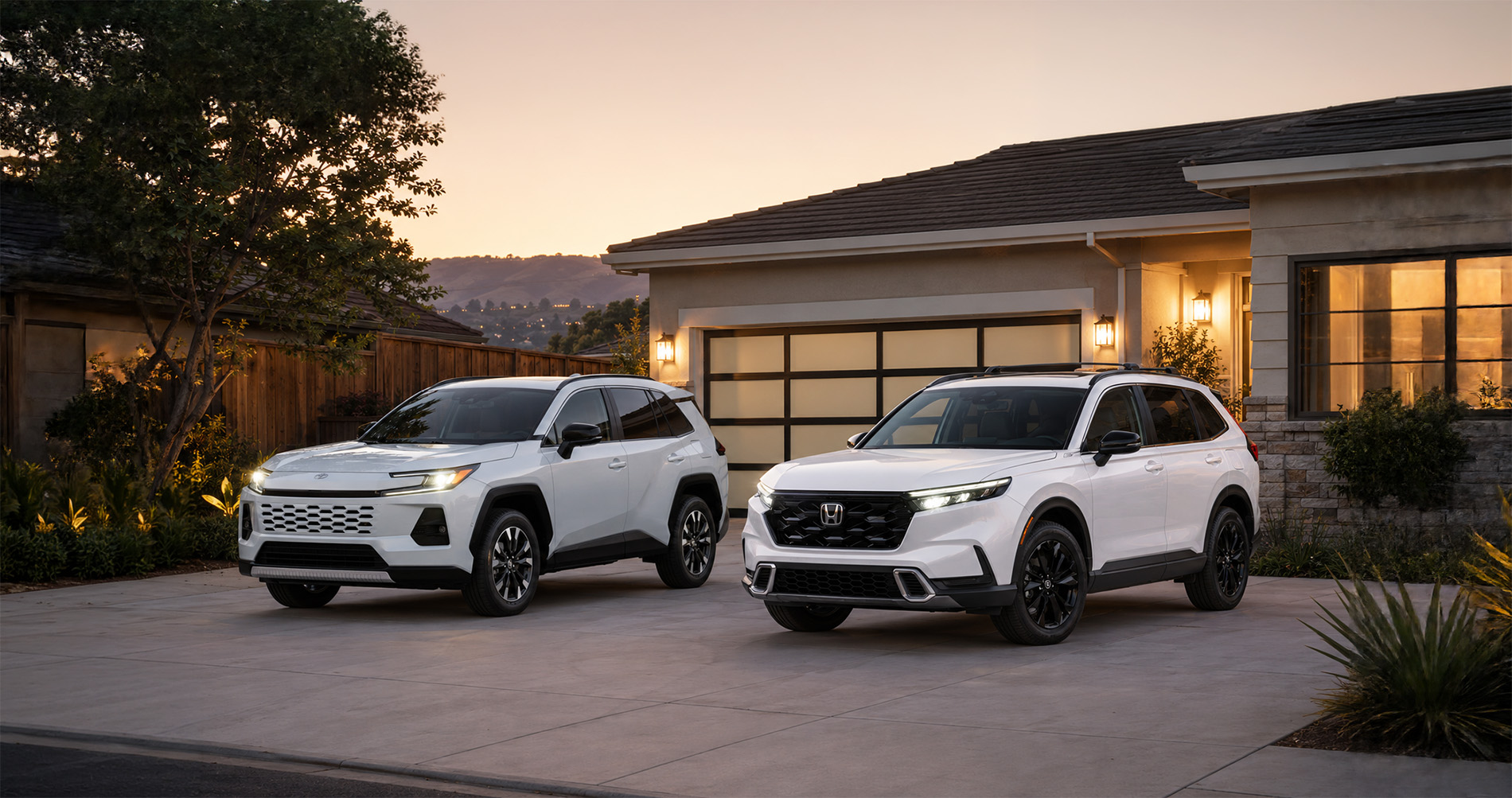


Two white SUVs—a 2026 Honda CR-V and a 2026 Toyota RAV4—parked side by side in a residential driveway at sunset in El Cerrito, California, with modern homes and soft lighting in the background, showcasing their sleek styling and hybrid efficiency.


Final Thoughts: CR-V vs RAV4

The 2026 Toyota RAV4 makes a strong argument for shoppers who already know they want an electrified compact SUV. Its higher hybrid MPG ceiling, lower hybrid entry point, Plug-in Hybrid availability, redesigned technology story, and Woodland trim give it real advantages. Those strengths matter most for drivers who want efficiency and utility to lead the decision.

The 2026 Honda CR-V makes a different argument. It is the stronger fit for shoppers who want more powertrain flexibility, a lower gas-model entry point, a roomier everyday cabin, practical cargo use, and a calmer compact-SUV ownership experience. The CR-V Hybrid adds fuel-saving value without changing the basic Honda mission, while the CR-V TrailSport Hybrid gives shoppers a rugged-leaning Honda alternative to RAV4 Woodland.

The right answer depends on priorities. Choose the RAV4 if MPG, plug-in availability, hybrid simplicity, and Woodland utility are the deciding factors. Choose the CR-V if your daily use centers on commuting comfort, rear-seat space, cargo flexibility, gas-or-hybrid choice, and a compact SUV that feels easy to live with every day around the East Bay.


Why Compare the CR-V at El Cerrito Honda?

El Cerrito Honda helps East Bay shoppers compare CR-V gas and hybrid trims with a practical, relationship-driven approach. The goal is not just to point you toward one model, but to help you understand whether the CR-V’s space, comfort, cargo flexibility, AWD availability, and hybrid options fit your commute, family routine, and weekend driving better than the RAV4’s electrified lineup.

For shoppers comparing compact SUVs around El Cerrito, Oakland, Berkeley, Richmond, Walnut Creek, and nearby East Bay communities, the CR-V is a natural model to evaluate in person. Sit in both rows, open the cargo area, compare gas and hybrid trims, and decide which setup feels right for the way you actually drive.


Where to Go Next

Use these links to keep comparing CR-V trims, view current inventory, estimate financing options, or value your trade before visiting El Cerrito Honda.


FAQ: 2026 Honda CR-V vs Toyota RAV4

Is the 2026 Toyota RAV4 hybrid only?

For 2026, the Toyota RAV4 is 100% electrified, with Hybrid and Plug-in Hybrid models rather than a gas-only RAV4. That gives the RAV4 a simpler electrified shopping path than the CR-V, which offers both gas and hybrid trims.

Does the 2026 Honda CR-V come as a hybrid?

Yes. The 2026 CR-V lineup includes hybrid trims such as Sport Hybrid, TrailSport Hybrid, Sport-L Hybrid, and Sport Touring Hybrid. Gas trims are also available.

Which gets better MPG, the CR-V Hybrid or RAV4 Hybrid?

The RAV4 has the stronger hybrid MPG ceiling. Toyota lists up to 47 city / 40 highway MPG on select RAV4 Hybrid trims, while Honda lists up to 43 city / 36 highway MPG on select CR-V Hybrid trims.

Which has more cargo space, the Honda CR-V or Toyota RAV4?

The CR-V has the stronger cargo-space story in many configurations, with Honda listing up to 76.5 cubic feet on select gas trims. The RAV4 remains practical, with Toyota listing 37.8 cubic feet behind the second row and 70.4 cubic feet behind the front row with the second row folded.

Which tows more, the 2026 CR-V or 2026 RAV4?

The RAV4 has the stronger towing advantage, with Toyota listing up to 3,500 pounds on select AWD trims. Honda lists up to 1,500 pounds for gas CR-V trims and up to 1,000 pounds for CR-V Hybrid trims when properly equipped.

Is the CR-V TrailSport Hybrid comparable to the RAV4 Woodland?

Yes, but they have different missions. CR-V TrailSport Hybrid is the rugged-leaning Honda hybrid for daily driving, rain, rough pavement, and light outdoor use. RAV4 Woodland is the stronger capability trim, especially for shoppers who want its tow hitch, higher towing rating, and outdoors-oriented equipment.

Which SUV is better for East Bay commuting?

The RAV4 is the stronger fit if your commute decision starts with maximum MPG or Plug-in Hybrid availability. The CR-V is the stronger fit if you want a roomier, more flexible daily compact SUV with gas and hybrid choices, comfortable seating, and easy cargo use.

What cities does El Cerrito Honda serve for CR-V shoppers?

El Cerrito Honda serves compact SUV shoppers from El Cerrito, Oakland, Berkeley, Richmond, San Pablo, Pinole, Hercules, Martinez, Emeryville, Alameda, Walnut Creek, Orinda, San Leandro, and surrounding East Bay communities.


DISCLAIMERS:
*MSRP, destination charges, dealer pricing, taxes, title, license, registration, dealer fees, accessories, incentives, and availability may vary. Always confirm current pricing, trim availability, installed equipment, incentives, and final transaction details with El Cerrito Honda before purchase or lease.
*MPG ratings are EPA estimates or manufacturer estimates where noted. Actual mileage will vary based on trim, drivetrain, driving conditions, traffic, weather, fuel, maintenance, terrain, vehicle load, accessory use, and driving habits.
*Towing ratings vary by model, trim, drivetrain, equipment, trailer type, cargo, passengers, and loading. Never exceed the vehicle’s rated towing capacity. Consult the owner’s manual and follow all towing, tongue-weight, braking, hitch, and load-distribution requirements.
*Cargo volume, passenger volume, ground clearance, dimensions, and feature availability vary by trim and configuration. Hybrid components, moonroofs, packages, wheels, accessories, and AWD systems may affect measurements and usable space.
*Driver-assistance and safety technologies are not substitutes for attentive driving. System operation can be affected by weather, speed, road conditions, visibility, traffic, sensor obstruction, and other factors. The driver remains responsible for safe vehicle operation at all times.
*Third-party ratings and awards are based on the cited publisher’s current review pages at the time of article preparation and should be rechecked before final publication.